Dear Daughters,
When I was 11 years old, I finally worked up the nerve to tell my mother I didn’t want to take piano lessons anymore.
It wasn’t easy. Piano felt expected in my home. Mom was the pianist at our church, and I had started taking lessons at five, following in my brother Tim’s footsteps (as I also did with soccer, swimming, and scouts).
It wasn’t that I didn’t love music. I did. For much of my early childhood, I fell asleep each night listening to my mother practice preludes, postludes, processionals, and hymns in the next room. To this day, I can sing you the entire Baptist Hymnal we used at church. Not every word of every hymn, but every tune that once drifted through the walls of my bedroom at night.
I just wasn’t a fan of piano practice. I had no interest in running scales, learning to read music, or even sitting still on a bench. Recitals were a form of torture: all pressure, no pleasure. The one part of piano lessons I liked? The “Garfield” comic books at the piano teacher’s house, which I read while Tim did his lesson.
The final straw was the practice timer. Having nagged me about practicing for years, Mom resorted to setting a kitchen timer every morning, leaving it on the edge of the piano, and ordering me to practice until it dinged.
Each day I would pray for time to move faster, for the space between “tick” and “tock” to mercifully narrow. This, of course, had exactly the opposite effect. Decades later, I would learn about “internal time dilation”—the experience of time seeming to slow down in stressful moments—and think back on that practice timer and its mysterious power to lengthen minutes.
After putting off the inevitable too long, I finally talked to Mom.
“I don’t want to take piano lessons anymore,” I said.
Dear daughters, the sky did not fall. The Earth did not shake nor the waters part. Mom actually smiled and gave me a hug.
“I figured that might be the case,” she said, “since you never want to practice.”
Phew. Off the hook. No more practice! No more timer!
“But I think you should keep playing music,” she continued. “You have it in you. You just haven’t found your instrument.”
I thought about that for a moment, then offered an unexpected idea.
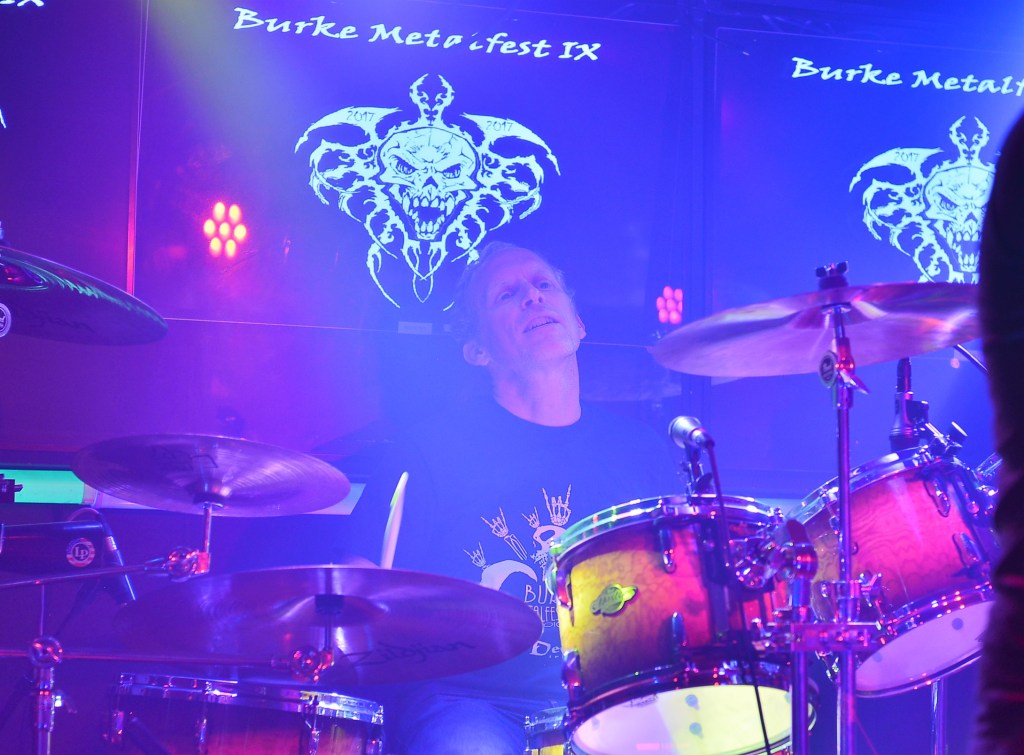
“Drums,” I said. “I want to play the drums.”
I’m guessing Mom was hoping I would pick trumpet or saxophone or even guitar, but I had recently seen a young woman at church play the drums. She was 18, pretty, and cooler than I ever imagined I would be. I remember her with glitter in her hair, though my mind may have made that up—either then or in the intervening years.
“Like Beth at church?” Mom asked.
The woman’s powers of perception were astounding. How did she know?
I nodded.
“Okay,” she said. “We can get you a practice pad and some sticks and find you a teacher. We’ll see how that goes.”
Two years later, I was playing on stage in the Edgar Allan Poe Intermediate School jazz band. My parents came to watch us perform, God love them. I cringe now to think how we sounded.
Around that time, I told Mom I wanted to get a kit of my own.
“Then I guess you should save your money,” she said.
So I did.
I mowed lawns all summer and put cash in the bank. Meanwhile, I wore out my practice pad. Flams, paradiddles, and triplets, oh my! Mom was right, I had music in me, and now I had found my instrument.
When I had saved enough money, I looked into buying a small, starter drum kit. All I could afford was the minimum.
“I’m sorry,” Mom said, “but we’re not doing that.”
She and Dad smiled knowingly at each other.
“We’re buying you a real instrument,” she went on. “Your Dad and I will match the dollars you saved so we can get you something nice. We’ll buy it used—musical instruments don’t go bad—but you’ve worked hard enough to deserve it.”
“It” turned out to be a five-piece Sonor kit, with Zildjian cymbals, Tama pedals, and extra Remo heads. Those names may mean nothing to non-drummers, but that kit meant everything to me.
A year later, I was in my first rock band: “RDA” or “Recommended Daily Allowance.” What we lacked in skill, we made up for in willingness to play shirtless and for free.
My parents let us practice in the basement of our house, which was soon filled with amps and guitars, along with my ever-expanding collection of percussion equipment. Each afternoon, I pounded away on the drums. Each night, I picked out new guitar chords and patterns, taught to me by my bandmates and practiced with no kitchen timer.
I even started playing along with Mom. She took me to weddings and had me turn pages. She used me as her personal metronome.
Every now and then, I even plunked away on her piano. I used it to pick out melodies. I played a simple piece here and there. I took a music theory class in high school and composed on it. I wrote a piece that imitated Bach, Mom’s favorite.
Mom’s piano still sits in our basement today. As for that drum kit we bought in 1984, I played it for 30 years, then sold it to a mother and daughter who were learning to play together. They paid me exactly what I had paid for it three decades earlier. I felt like Mom was winking at me from above.
I bought myself another drum kit, of course. I now have three. And I’m still playing in a band. We wear shirts, and we’re cheap but not free.
In the intervening years, I’ve read a lot about the importance of practice—from the popular claim that it takes 10,000 hours to master anything to age-old arguments that practice does more than build skills: it shapes who we are as moral beings.
What’s clear to me, both from the literature and from personal experience, is this: practice makes persons. We humans become what we practice being. People who practice piano become pianists. People who practice drums become drummers. Likewise, people who practice courage become courageous, and people who practice kindness become good and decent and worthy.
Shakespeare was channeling Aristotle when he wrote the following lines:
Assume a virtue, if you have it not …
For use almost can change the stamp of nature.
In other words: If you don’t have a virtue, fake it till you make it. Literally. The same powers of habit that can turn us into monsters can also make us better humans. Practice (“use”) can almost change our natures.
Almost.
And this is where my mom’s wisdom shone through clearest. She didn’t let me quit practicing, but she did let me change what I practiced. She helped me find a habit, an instrument, an art I was willing to work at.
Practice makes persons. But never so much as when the practice and the person suit each other so well that the person practices willingly every day. Never so much as when the practice becomes an integral part of the person. Then the woman becomes a pianist whose playing lulls her children to sleep. Then the man becomes a drummer for whom every object is a potential percussion instrument.
Sometimes we get to choose what we practice. Sometimes we don’t. Always we have the choice to strive to make ourselves better. To practice virtues. To practice art. To practice living as wisely and well as we can.
Now and then, we get a chance to help someone else discover a practice that brings them joy. We get to help them find their own instrument, their own art, their own voice. This is an extraordinary gift. The one my mom gave me.
I didn’t become a professional drummer. But along the way I found a practice I loved just as much—wordplay, storytelling, the writing craft I’m practicing even now. Mom didn’t teach me the piano or the drums. She did teach me to keep trying and testing and searching till I found something I’d practice willingly every day.
She’d be glad to know I’m still at it. Word by word. Line by line. Beat by beat.
Love,
Dad
Discover more from Truths & Wonders
Subscribe to get the latest posts sent to your email.

My mom used the exact same torture device (kitchen timer) for my trumpet practice. Glad you eventually found the drums (and wordplay!), though I kind of feel bad for your poor piano teacher enduring all those Garfield comics 😅
LikeLiked by 1 person