Dear Daughters,
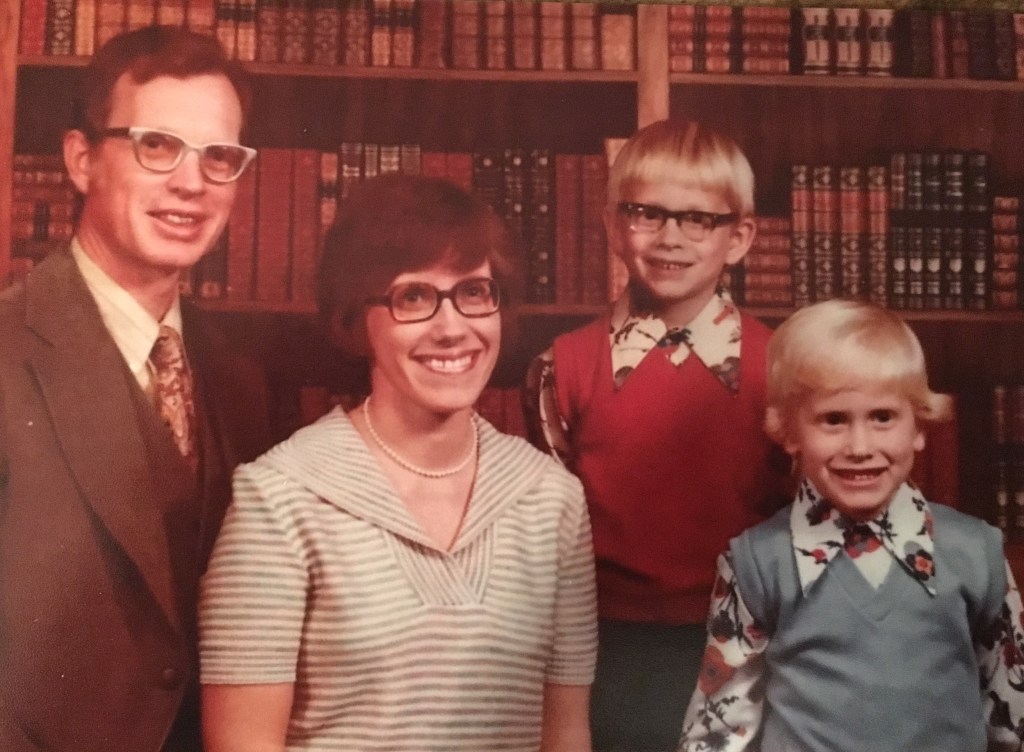
Twice a year every year of my childhood, my family would drive to Parkersburg, West Virginia, to visit my grandmother.
Back in the olden days of the 1970s, these trips could be pretty horrific. Our family car, a 1970 Chevy Nova, featured a malfunctioning AM-only radio, no air conditioning, and golden, faux-vinyl seats. The four of us would pile in, often with our dog, Muffin, and take the Nova up old Route 50 West, on an eight-hour, switchback-filled journey over the Shenandoah River and through the Blue Ridge Mountain woods to grandmother’s house.
The trip featured fantastic scenery and regular motion sickness. I remember my brother, Tim, vomiting by the side of the road with my saintly mother, a nurse by trade, standing with her hand on his forehead. I’m sure he remembers similar scenes of me with Mom.
We might have made the trip less frequently, if not for two things:
First, Grandma was thrilled when we visited, and she poured on the sweets to prove it. She had homemade cookies waiting for us every time we walked through the door. Plus fresh-baked pies and cakes for every dinner and Lucky Charms for breakfast, which Mom wouldn’t buy us at home. Tim and I might have felt sick when we arrived, but Grandma cured us with carbs.
Second, Grandma also wasn’t afraid to play the guilt card on Mom—the eldest of her three daughters, and the one who had moved farthest from home. Before the end of each visit, Grandma would hug Mom and say something like, “Thanks for coming, dear. I may not have much time left on this Earth, so seeing you and the boys is important to me.”
Mom hated being guilt-tripped like that, but she was still susceptible to it: Grandma got family visits every summer until I went away to college, and every year on either Thanksgiving or Christmas, too. Even before I officially became an adult, she started laying the guilt trips directly on me.
During the winter visits when we were kids, Tim and I slept in the unheated, uninsulated attic of Grandma’s house, fully clothed and huddled beneath an electric blanket that formed a thin blue synthetic line against the cold. I remember Christmas Eves when we couldn’t sleep but could see each other’s breath in the moonbeams as we talked late into the night.
My memories of Parkersburg are mostly like that: sweet and filled with love, with occasional bits of frost around the edges.
Eventually, the drives got better. New cars, Dramamine, and the interstate highway system conspired to straighten the country roads. Unfortunately, even as the world made progress, Grandma began to fade. She finally had to move out of her house and into the nursing home across the street.
Then my Uncle Mike died from non-Hodgkin’s lymphoma. The following year, my mom followed him into the great beyond, cut down at 59 by ovarian cancer.
The last time I saw Grandma, she told me she had prayed for months that God would take her instead of Michael, and then instead of my mom. But God doesn’t work that way, and Grandma seemed wounded and wearied by the fact. When we said our goodbyes for what would be the last time, she didn’t even muster a guilt trip.
The last time I drove to Parkersburg was for Grandma’s funeral. The trip was easy and quick. And it made me think about just how much faster the world was moving than it did when I was young. It also made me think about just how little that mattered.
We want to go faster and faster these days, even when we don’t have a clue where we’re going. And even when the scenery was better the other way. We want to rid the world of discomforts, even at the cost of thinner skins and fragile souls.
The older I get, the more convinced I am that this is foolish. Deeply so.
Faster isn’t necessarily better. Newer isn’t necessarily better. Easier isn’t necessarily better. Only better is better. And “better” has to mean better for deepening our humanity, for feeding the better angels of our nature (by whatever name you call them), for growing our souls. The better way isn’t the easier one; it’s whichever one leads to fulfillment.
I don’t know for certain that suffering the switchbacks of old Route 50 built character in Tim and me, or that shivering in Grandma’s attic made us tougher in any way. But I’m sure that it didn’t hurt us. And I’m sure that Grandma was right about this: Gathering the family to eat and laugh and make merry together was worth it, guilt trips and all. Homemade carbs really do have curative properties.
We’re never going to eliminate the suffering from human life. That isn’t in the cards for any of us. We can move faster and make more and try to smooth out all the edges of existence, and we’ll still wind up losing our moms and our uncle Mikes.
A quick and easy trip to a funeral is no way to live.
Thankfully, it’s not our only choice. The better way is not to try to rid the world of discomfort and annoyance but to fill it with joy and wonder. You can take a little sickness for the sake of homemade cookies. You can take the coldest night for Christmas morning.
Sometimes the winding country road is the one that leads you home. Don’t ever be afraid to take that one. If it ends better, it is better.
Love,
Dad
Discover more from Truths & Wonders
Subscribe to get the latest posts sent to your email.
