Dear Daughters,
A month or two before your mother and I got married, we sat down with our officiant, James Lamkin, to discuss our wedding ceremony. James was the pastor at Ravensworth Baptist Church, where I’d grown up. He knew my family well, and he’d agreed to officiate our wedding even though we weren’t having it at RBC.
We met him at the church on a warm May afternoon. Your mom and I sat across from him in his office, probably looking a little nervous. Thankfully, James had a wide smile, kind eyes, and a hearty laugh.
“So,” he said, leaning back in his chair. “Tell me what you’re thinking about your vows. Writing your own? Looking for something more traditional?”
“We don’t want to write our own,” your mother said.
“We thought it would be nice to use traditional words,” I explained.
“But we’re not interested in any talk about ‘obeying’,” your mother added.
James smiled. “Got it,” he said. “Traditional but not too traditional. We’re not going back to the Dark Ages here.”
We both chuckled.
“Back then,” he said, “the vows ended with the phrase, ‘And thereto I plight thee my troth’ … Whatever a ‘troth’ is.”
Dear daughters, I couldn’t help myself.
“Actually,” I said, “troth is a cognate of truth.”
James laughed his hearty laugh.
“Well, there you go,” he said, pointing at me. “Mary, you’ve found the only groom I’ve ever met who knows what a ‘troth’ is.”
Mary looked at me as if to say, “Oh, don’t I know it.”
“To plight your troth meant to pledge your sacred honor,” I rushed to explain. “It sounds old-fashioned and corny now, but the idea was a good one. It meant that you were promising to share your deepest self with someone—and to take care of their deepest self in return.”
James smiled and nodded, brown eyes twinkling. “That’s actually pretty great,” he said.
The Most Glorious Day
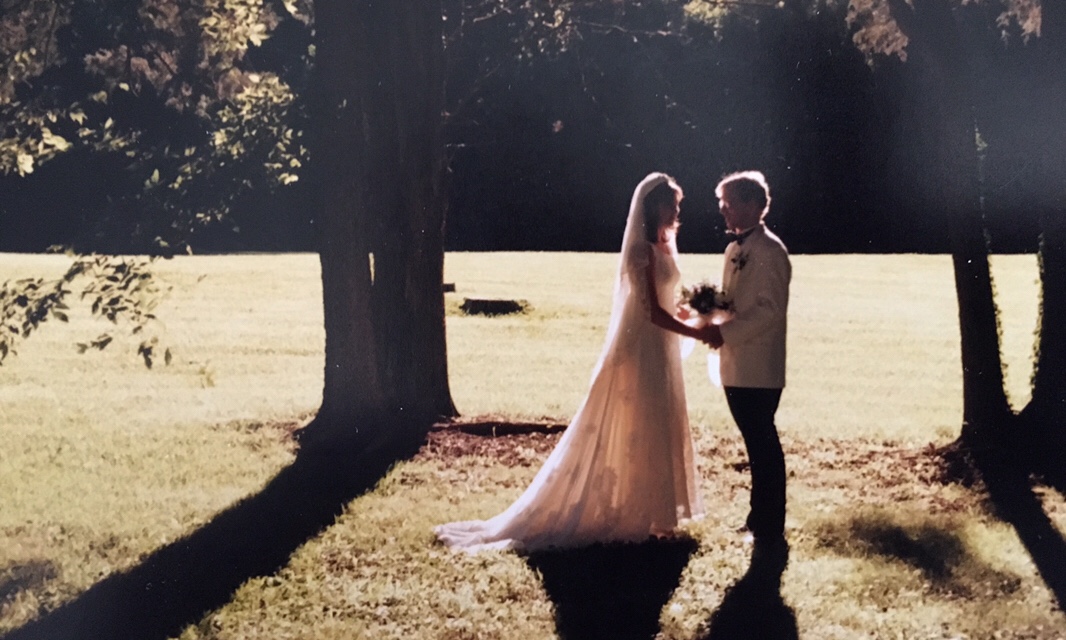
Two months later, on July 20, 1996, your mom and I stood on the stone patio at Poplar Springs in Warrenton, Virginia to say our vows. The weather was perfect—80 degrees, no humidity, clear blue skies—and practically everyone we loved was there.
During his homily, James told the troth story.
“Steve and Mary are both teachers,” he noted. “Mary teaches fourth grade. Steve tutors college students and is studying to be a Shakespeare scholar. They’re what you might call ‘lettered people’—comfortable with books, words, ideas.”
He paused for effect.
“A couple of months back, when we met to discuss this ceremony, I mentioned that the old English wedding vows ended with an ancient-sounding phrase: ‘And thereto I plight thee my troth.’ Then I added—kind of as a joke—’whatever a troth is.'”
People chuckled.
“And Steve immediately says, ‘Actually, troth is a cognate of truth.'”
More laughter.
“Now, I’m standing there thinking, ‘Okay, sure, Steve. But also: What’s a cognate?'”
The congregation laughed harder. James waited for it to settle.
“Of course,” he continued, “Steve had a point. He was recognizing the power of the words we use and the truths we can only tell when we live with one another in deep bonds of trust.”
The rest of James’s homily was a meditation on the fact that our married life would bring days filled with “poetic possibilities,” days of “severe prose,” and many comparatively mundane days between. The key to success was staying true to one another through them all.
And That’s the Troth!
A few months later, James sent me a copy of a newsletter piece he’d written about the experience. He told the story again, made the joke about not knowing what “cognate” meant, then signed it: “And that’s the troth!”
I’ve kept that newsletter for thirty years.
I’ve also kept the troth I plighted. To your mother. To myself.
Thinking back all these years later, I can’t remember why I knew the history of “troth.” (“Cognates,” by the way, are just words from different languages that share the same root.) Too much time in the stacks at the Folger Shakespeare Library, I suppose, or with my nose between the pages of the Oxford English Dictionary.
Even then, I was fascinated with how words can express the truth without actually containing it, and how humans can use language to be true to one another or not. I was also interested, as I am to this day, in how serendipitous moments can suddenly order our lives in remarkable ways.
Somehow—via James’s warmth, my nerdy word knowledge, and a humorous turn in our prenuptial conversation—my long-running fascination with the word “truth” ended up at the center of the most important truth I’ve ever told: the promise I made to your mother on our wedding day.
There’s something simultaneously strange and wonderful in that, something I still don’t fully understand. Sometimes the most important things find their way into our lives sideways, serendipitously, via accidents that aren’t quite accidents and that tend to spill out as laughter. What I know now, better than I knew it then, is that you must embrace such moments fully when they occur.
The phrase, “I plight thee my troth,” has been close to my heart ever since. It has reminded me of poetic possibility on days of severe prose. It has functioned as a kind of deep magic amid the otherwise mundane. It continues to make me smile.
It’s a 1,000-year-old phrase that articulates a 30-year-old promise that helps to define the me I still hope to be. And, as James would say, “that’s the troth!”
My advice? When you find the right person, plight your troth and mean it. And when serendipity strikes, lean in.
Love,
Dad
This letter is part of my memoir-in-progress, “Wonders All the Way Down.” Read a sample chapter here.
Discover more from Truths & Wonders
Subscribe to get the latest posts sent to your email.
