Dear Reader,
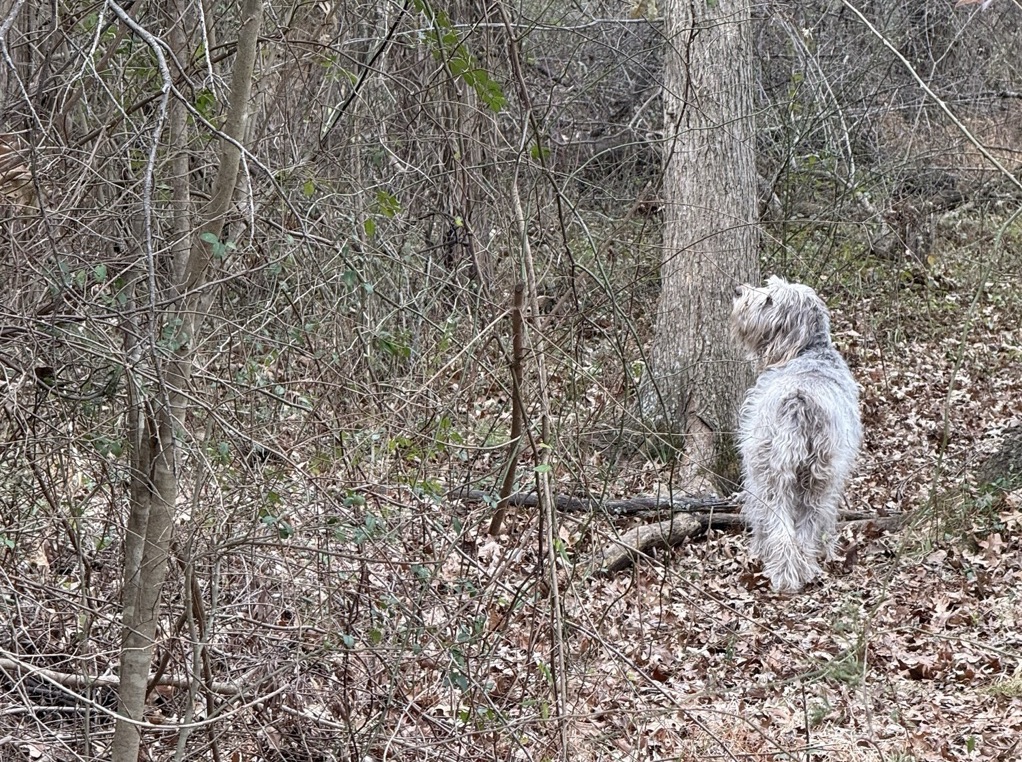
A few mornings ago, I was out walking Bob and Nellie—my Italian Spinoni—through the woods behind our house. My head was abuzz with the sort of information that overloads us all these days, until I walked into a swirl.
Perhaps two dozen winged creatures, like tiny butterflies with pale blue wings, fluttered up around me from nowhere. Roughly the size of honeybees, they floated on the April air and danced in multiple directions at once—up and down, left and right, in lines or arcs or circles as chance or circumstance moved them. I had no idea what they were.
On the spot, I decided to call them “pinafores.” For no particular reason, really, other than the sound of the word and the shape of their nearly translucent wings, which reminded me of a light-blue smock my mother used to wear when we did arts and crafts at the kitchen table in our house on Moultrie Road.
As quickly as they had risen up and swirled around me, the pinafores moved off into the trees, and I thought for a moment about how people living in ancient times—or in ancient forests today—might have seen such creatures as faeries.
Even for me, walking my suburban Spinoni in 2026, their presence felt like a kind of magic. The pinafores were the woods suddenly swirling up around me. Or, more precisely, they were the life of the woods suddenly breaking through to my consciousness.
Strangely enough, I experienced this manifestation of terrestrial life as almost alien. Distracted as I was by the buzz of information in my head, the living world showed up uninvited. If not for the swirling dance of the pinafores, I might have missed it entirely. Not because it wasn’t there, living, swirling, unfurling all along. Because I wasn’t alive to it.
The Itch to Capture and Contain
Further down the path, I heard a bird call out in the distance, using a song I didn’t recognize. Another of its type answered the call, and the two began an elaborate back-and-forth duet atop the trees.
I wondered what they were, these chatty birds.
For a moment, I was tempted to pull out my phone and try to record their exchange—to identify them, classify them, and so “know” them properly. But I stopped myself.
Inspired by my experience with the pinafores, I decided simply to listen. I named the birds “lollygags,” after the sound of their song, and resolved to appreciate the lollygags and pinafores alike from afar. By giving them some distance, I realized, I might come to know them differently.
The phone is a modern invention, but the itch to classify—to pin down, to immediately resolve experience into information—is ancient in humans. Modern tech makes the itch omnipresent. Worse, our apps enable us to scratch the itch immediately, and then to mistake the omnipresence of such itching and scratching for a form of omniscience.
We assume that what the web returns from a Google search or an AI prompt is the whole of what’s real.
It isn’t. Not even close.
The forest is real. The pinafores and lollygags, by whatever names we call them, are real. The web is at best a map, not the territory we seek to discover. Neither Google nor AI can even experience the territory. Theirs is an extra-terrestrial form of intelligence: All digital, ungrounded. They have terabytes of data, but they can’t touch grass.
A Different Kind of Knowing
To look something up is always, in a sense, to try to pin it down. Sometimes that’s a worthwhile tradeoff. It’s very much my normal mode: People pay me to research things and to find the right words to describe them. To look them up and pin them down.
But this isn’t the only possible way to experience the world. It isn’t the only way to exist in a forest with the swirl of life around you—or anywhere else life swirls, which it always and everywhere does. And systematically privileging this way of looking, this mode of experiencing, is a form of delusion.
The detached, objective, scientific gaze has crucial uses, no question. But it closes off a great deal, too—modes of experience that are more subjective, more embodied, more alive to the wonderful strangeness of the world and its inhabitants. Other modes of experience can whisper living truths, sometimes in languages we don’t yet speak.
Coming Alive vs. Avoiding Death
Having looked upon the pinafores and listened to the lollygags, I thought about the people who dream of uploading their minds into the digital cloud and living forever. There’s something deeply human about that dream. And something deeply misleading—not just technically, but existentially.
What on earth would be uploaded? Not, I’m guessing, the way a smock worn by a mother long ago can still color the wings of a “faerie” on an April morning.
Not the feel of walking into a swirl.
Not the sort of wonder that wakes you from your everyday data processing and prompts you to look and listen. Not merely to see and hear, mind you, but to come alive yourself.
The truths and wonders that most interest me are aspects of that aliveness. They don’t exist outside or beyond it. They’re not waiting to be retrieved from a server somewhere. They are immanent.
We don’t find them by escaping our terrestrial surroundings. We find them by living in the world more fully: by getting goosebumps and prickles on the backs of our necks; by having to catch our breath or feel our hearts race. By pinching ourselves to prove what’s true.
In and Around and Through
I’m not suggesting we should all delete our to-do lists and dance off into the forest in pursuit of fantastical creatures. I am suggesting that finding moments of wonder within the flow of ordinary life is essential. And I’m insisting that we shouldn’t slam the door on such moments when they arrive, or dismiss them as flighty or foolish.
We should never allow the terabytes to overwhelm our wonder. We should never allow perpetual noise to make us deaf to music.
The point is not to add “Be fully alive!” to our to-do lists as yet another task or downloadable app. The point is to find ways to be fully alive in and around and even through the to-dos. The pinafores and lollygags didn’t wait for me to finish my dog walk. They showed up when they showed up.
The real question—the one that really mattered on that morning in the woods—was whether I was willing to pay enough attention to notice them, to exist with them, and to let them live with me.
I’m glad to say, on that day, I was.
And I’m going to strive to continue to be.
Best,
Steve
Discover more from Truths & Wonders
Subscribe to get the latest posts sent to your email.

Two experiences that help me come alive in the present moment are being in nature or being with my young grandchildren. Both are wonderful living mentors, purveyors of awe.
LikeLiked by 1 person
Thanks for sharing. May they keep purveying awe and helping you come alive!
LikeLike