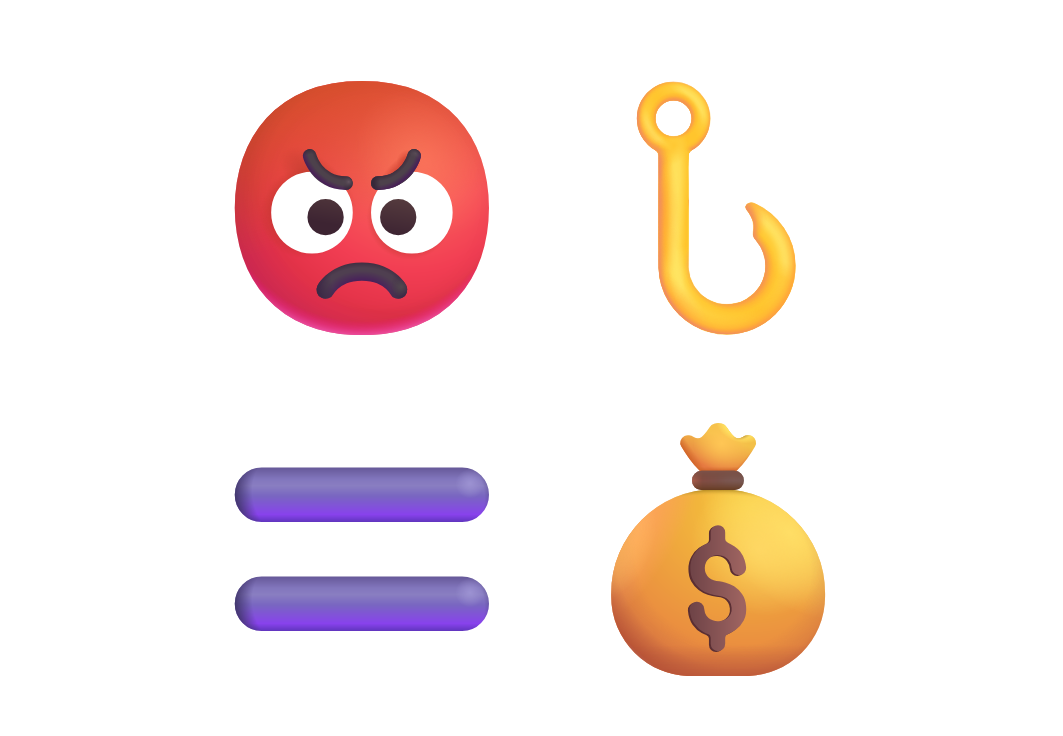
No one wants to be mad all the time. So why does social media constantly tempt us with rage bait? And why do we consistently bite?
Dear Reader,
Oxford University Press recently announced its Word of the Year: “Rage bait,” which it defines as “online content deliberately designed to elicit anger or outrage by being frustrating, provocative, or offensive.” (If “rage bait” seems like two words to you, don’t get enraged. Oxford counts compounds and explains its decision here.)
Rage bait comes in a wide variety of forms: Cooking videos with seemingly inept chefs boiling steak in milk; influencers posting about why they don’t believe in tipping or taking turns; political pundits sharing takes so stupid you want to tear your hair out.
Why?
Because it works! A New York University study found that posts containing moral and emotional language are 20 percent more likely to be shared than others.1
“Even if the emotions aroused are negative?” you ask.
Yes! Researchers at Yale actually determined that “people learn to express more outrage over time because they are rewarded by the basic design of social media” for doing so.2
Which leaves us with a bigger question: “Why?” How is it that anger—a negative emotion—has become so appealing online that we just have to have more and more of it? When and how did we become a bunch of rage junkies?
The short answer is that the rage baiters aren’t actually feeding us anger so much as dosing us with feelings of superiority, self-righteousness, and belonging. For the more complete answer—plus recommendations for breaking the rage-bait cycle—read on.
The Attention Economy Is Bound to Enrage You
To understand how rage bait works, you first need to get your head around this inconvenient truth: The digital world isn’t built to inform or even entertain you. It’s built to extract your attention and convert it into money for someone else. And “rage”—or whatever you want to call that feeling you get when you see something obviously wrong and feel compelled to respond—is among the most efficient ways to do that. Rage bait isn’t a bug in the digital media code. It’s central to the business model.
Digital media platforms don’t care if you’re happy or miserable, coddled or confounded. They just care that you keep scrolling.
In the eyes of the almighty algorithm, your angry comment and your enthusiastic like are the same. Both prove that the content in question captured your attention. Platforms reward high engagement with more distribution. More distribution means more ad impressions. More ad impressions mean more money.
Creators serve up content that’s stupid, erroneous, or morally offensive on purpose. You see that content and think: “I need to say something about this.” The moment you do—the moment you decide to comment, share, or even just pause to compose a response—your attention has been extracted. You’ve become the product sold to the highest-bidding advertiser.
The platform just transacted all over you. And to tell the truth, you probably liked it.
The Rage Is Just the Beginning
Here’s a second inconvenient truth: When transactions like this take place, you’re typically not enraged (at least, not for long).
When you watch someone cook incorrectly, violate a social norm, or even post a political take that’s obvious nonsense, you’re not being subjected to helpless, visceral anger. You’re being invited to pass judgment. And unlike rage, passing judgment feels good.
You get to say to yourself, “I would never do that,” “I know better than that,” “I’m not judgmental, but I have to say…” You get to engage in what psychologists call “downward social comparison.”
Humans assess self-worth by comparing ourselves to others. “Upward social comparison” (looking up to people we perceive as better) can be inspiring and uplifting, but it can also lead to envy, frustration, and resentment. “Downward social comparison (looking down on those we perceive as worse) feels inherently validating. It boosts our self-esteem without requiring us to accomplish anything.
The complete rage-bait experience is custom-built for downward comparison.
“Even I can cook better than that!” “At least I’m not a jerk like him!” “I’d make a better leader than that moron!”
I get to be right. I get to feel superior. And that feels good.
You and Your Righteous Mind
In some cases, the experience runs even deeper. Not only do we get to be right, we also get to feel righteous.
In his book The Righteous Mind: Why Good People Are Divided by Politics and Religion, psychologist Jonathan Haidt argues that humans have built-in moral “taste buds”—foundations that shape our intuitive sense of right and wrong. In the political sphere, rage bait often works by triggering these moral foundations—core sensibilities like fairness, harm, loyalty, and sanctity.
In some cases, a political take isn’t just dumb, it feels diabolical. It isn’t just an affront to truth, it smacks of treason.
In the face of such provocations, you’re not just annoyed. You’re called to defend something sacred. And when you do, you get to feel righteous in addition to right.
You’re also likely to be backed by those who feel like you do. Condemning the “enemy” earns kudos from “friends.” Your pushback gets its own likes and comments.
Suddenly, you’re an influencer yourself. You have a team, a shared mission, and a sense of belonging. Now you’re right, righteous, and included! The initial rage might have been unpleasant, but the ultimate reward is pretty awesome.
How Bad Actors Exploit This
Once you understand how this cycle works, you’ll notice it everywhere online. Common examples include the following:
Incompetence Traps
Someone makes a cooking video where they boil steak in milk or build a tower of processed cheese. These aren’t accidents. They’re performances explicitly designed to trigger your judgment.
The creator knows you’ll watch, horrified. They know you’ll comment: “This is disgusting.” “What a waste.” “Who would eat this?” They know every one of those comments is money in their pockets.
Fix-It Gimmicks
The digital world includes a wide array of intentional errors. Misspelled words and deliberate typos designed to elicit your “help.” Obviously wrong facts, designed to be corrected by the better informed: “I love my Mustang! Best car Dodge ever made!” (Some Ford lover out there is dying to correct my stupidity even now, despite what I just said.)
Such traps are specifically designed to attract people who pride themselves on being informed and careful. People like me and you, dear reader!
The Propaganda Machine
The rage-bait cycle would seem pretty silly and harmless if not for its role in polarization and online politics, where it takes a decidedly dark turn. Here, the game isn’t about making dumb mistakes for the sake of money. It’s about driving division and misleading the public.
Political rage farming works as described above: It triggers your moral foundations, invites you to pass judgment, and extracts your engagement. But the primary goal is power rather than profit.
Think about how Donald Trump uses social media. Posts are frequently calibrated to produce maximum outrage from critics. The point is not to communicate ideas. The point is to provoke, enrage, and invite recriminations from the president’s critics—which in turn summons supporters to his defense. The more people engage—whether in disgust or defense—the more Trump sucks down our collective attention.
Students of propaganda recognize this as a “flood the zone” strategy. Produce provocative content so fast that no one can keep up. Keep your opponents enraged and overwhelmed. Keep your supporters busy defending you and “owning” the opposition. Capture everyone’s attention, and make the controversy you’re driving the day’s top story. Meanwhile, keep aggregating power and wealth for yourself.
This is how propaganda works in the age of algorithms. This is how the age of algorithms puts propaganda on blast and eviscerates truth.
Escaping the Rage Cycle
If you’re tempted at this point to disconnect from it all, you’re by no means alone. Even in our highly polarized era, people across the political spectrum agree that algorithm-driven rage has become a serious problem. So why not just disengage entirely?
Because some claims really are worth resisting. Sometimes you really do we need to fight for what’s right, online and off. We can’t afford to let Truth Social decide what’s true.
We have to escape the rage-bait cycle without just shutting down. But how?
First, learn to spot the bait before you take it. Beware of …
- All-or-nothing language: “Everyone knows,” “Nobody thinks”
- Invitations to conflict: “Hot take,” “Unpopular opinion,” “Change my mind”
- Obvious errors that seem too dumb to be real
- Performances of incompetence
- Moral extremity that makes you think, “How could anyone seriously believe this?”
If your first instinct says, “I need to correct this immediately,” take a breath. There could be a hook beneath that dangling bait. No reason to bite haphazardly.
Second, stop and ask, “How can I respond most effectively?”
Rage baiters want you to act on impulse. They want you to feel enraged, then right or righteous, while they take more and more of your attention.
Never forget that your time, attention, and energy are finite and precious. Never forget that the digital world is designed to suck them from you remorselessly. Every minute you spend performing righteousness for an algorithm is a minute you’re not spending on something that could make the world better—or at least help restore your sanity.
When a claim is worth resisting, spend your time, energy, and attention wisely. Organize with others, contact representatives, support (and share!) journalism that exposes real problems, help people who want to understand better. Contribute to solutions, not divisions.
Don’t try to fix an error for someone who’s making it on purpose. Help others find a better way instead.
The Bottom Line
Rage bait works because you’re not just being victimized. You’re being offered a transaction: Give us your attention and emotional energy, and we’ll give you a hit of superiority, a dose of self-righteousness, and maybe even a sense of belonging.
Bad actors systematically exploit this cycle, hooking us with everything from silly cooking videos and intentional typos to political propaganda designed to dominate the discourse and drive division.
Once you understand the model, you’ll notice it everywhere online. And once you see what’s actually happening, you can choose to engage wisely (or not at all).
The key is to avoid taking the bait even when you see a fight worth having. Take a breath instead. Then engage deliberately and strategically, where your attention and energy can make a difference.
Never mind the interactive indignation. Find your actual moral footing. Then work to change what’s wrong.
- https://www.nyu.edu/about/news-publications/news/2017/june/messages-with-moral-emotional-words-are-more-likely-to-go-viral-.html?challenge=d06e90d7-4d8f-4b88-9d8c-10b73beb60f1 ↩︎
- https://news.yale.edu/2021/08/13/likes-and-shares-teach-people-express-more-outrage-online ↩︎
Discover more from Truths & Wonders
Subscribe to get the latest posts sent to your email.
