Three lessons I learned while ruining books.
Dear Friends and Colleagues,
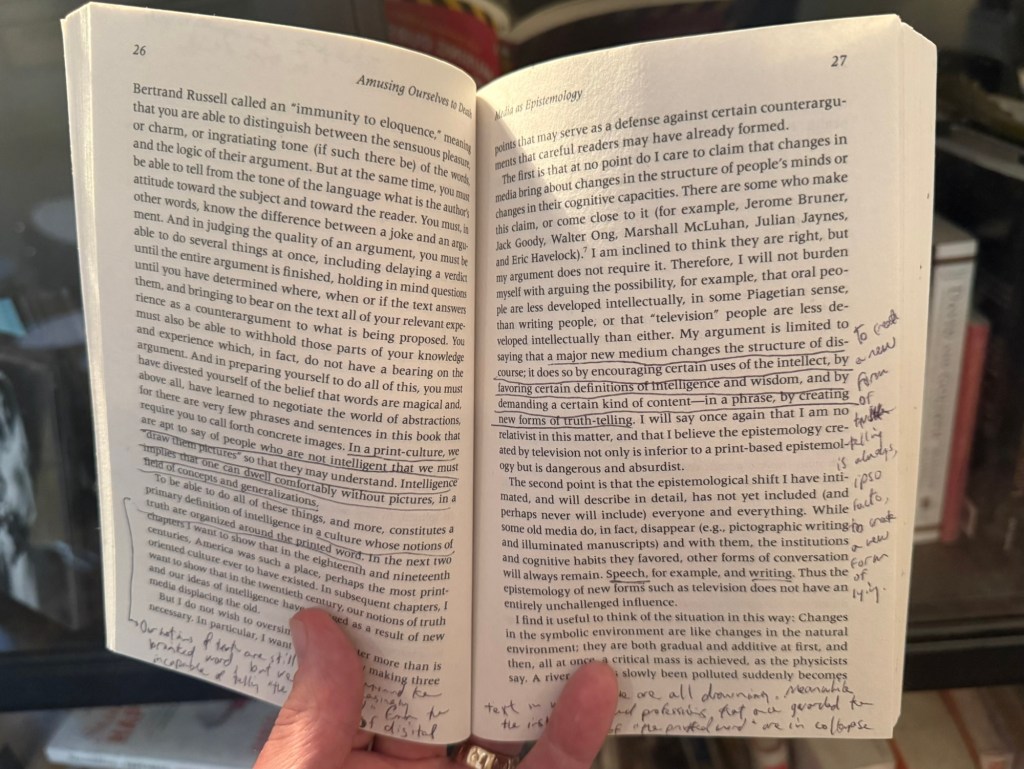
I’m one of those people who ruins the books he reads.
I write all over them.
I underline. I make notes in the margins. I scribble summaries at the ends of chapters and on blank pages. I draw (terrible) diagrams trying to connect ideas.
I can’t help myself. For me, reading is a dialogical adventure, a quasi-miraculous form of conversation, a chance to engage with another mind from far away in space or time.
Thanks to many years of practice, I’ve developed the ability to read quickly at a surface level, to skim the basics out of even difficult treatises. But that isn’t the sort of reading I like.
The sort of reading I like is slow and meandering, repeatedly interrupted by the aforementioned underlining and scribbling and note-making.
It’s neither a skim nor an effort to summarize. It’s an all-too-brief marriage of true minds, or it’s an intellectual wrestling match, or it’s a chance to marvel at what another person perceives and puts into words.
It’s part of the larger quest for shared understanding. (Which is not to be confused with “information” or even “communication,” insofar the former is conceived as formatted noise and the latter is conceived as the transmission of formatted noise.)
I read because I want to understand what another person thinks and feels and knows. I read because I want to find meaning together with them.
Close Reading Is Like Careful Listening
Over decades as a writer and editor, I’ve also discovered the following: People typically respond positively when I read what they write and engage with the aforementioned gusto, even when I disagree with them or push them hard to explain their ideas more clearly.
As long as I critique their ideas, not them, most people interpret my close reading and (sometimes) demanding editorial feedback as precisely what it is: an effort to better understand what they have to say. And most people really do want to be understood. Not just to be rewarded with a “like” or a “laugh,” but to be heard.
More than once, I’ve delivered tough (if helpful!) editorial commentary and received a response that said, roughly, “thank you. I wasn’t sure if anyone was actually listening.”
One of the great challenges of our age is that we continue to generate vast amounts of information without actually listening—without engaging deeply, asking hard questions, grappling toward answers, and seeking to understand.
Sometimes we assume that others will be put off by questions and concerns. But when they experience our efforts as good-faith efforts to understand them more fully, and not as willy-nilly criticism, they are often relieved and even excited.
In a world full of sound and fury, another person trying to understand you signifies something. Even if they don’t agree. Even if they don’t yet understand as you do.
From Marginal Notes to Meaningful Leadership
Over the years, I’ve also noticed a parallel between this approach to reading and the approach to leadership that people I respect typically take. The best leaders I know don’t just skim through—they engage deeply and commit fully.
They don’t ignore complexities or multitask through meetings. They listen closely. They ask questions that push thinking further. They draw connections between different perspectives, and they create space for meaning to emerge through dialogue.
Their teams typically respond with the same relief I described above: “Someone was actually listening.”
In organizations drowning in information, the leader who engages deeply—who “ruins” the perfect slide deck with questions and suggestions, if necessary—is the one who helps transform noise into understanding. Such leaders create environments where people feel heard rather than glossed over.
The collaborative meaning-making that follows is where innovation and commitment are almost always born, at work as in close reading.
In the end, none of us wants to be skimmed. All of us want to find readers who ruin the book. We want to find them and keep them and build understanding with them. Because that’s where meaning begins.
So, go ahead and underline. Scribble and sketch and question. Do whatever it takes to let yourself fully engage—to read and think and write back.
The right people will love you for it. And those people are the ones who are worth reading carefully and striving to understand.
Those people are the ones worth leading. They are also the ones worth following.
Best,
Steve
Discover more from Truths & Wonders
Subscribe to get the latest posts sent to your email.
